A Museum Visit Built Around One Object
A museum visit built around one object reveals how Eastern cultural heritage carries layered histories, from visible craft details to the limits of a label.
A museum visit built around one object can make the layered histories of Eastern cultural heritage easier to see. Begin with a ceramic bowl, woven textile or carved figure from a named place, and look closely before reading its label: marks and materials are visible, while their meanings need evidence.
Choose a place-linked object
Start with an object whose label connects it to a particular region, community or tradition. A Chinese blue-and-white bowl, a Japanese textile or a carved figure from South Asia may each invite questions about materials and making, but none stands for an entire culture. Let the museum’s own attribution guide your choice, and keep the place named there attached to your notes.
Pick something you can see from the permitted viewing area. Look for a feature that catches your eye: a repeated motif, a joined edge, a repair or a contrast between smooth and rough surfaces. If the case is crowded or the light hides the detail, choose another object rather than straining or blocking someone else.
Keep the first question modest. What can you describe without knowing the object’s story? That distinction matters especially in galleries where a familiar-looking pattern can tempt visitors to assign a meaning or origin the display does not establish.
Observe the making
Take in the whole object first. Notice its shape, balance and orientation. A vessel may suggest pouring or storage; a textile may suggest clothing, furnishing or ceremonial use. Treat these as possibilities, not settled facts: form alone cannot establish how an object was used or who used it.
Then follow the visible details. Look for changes in colour, texture, shine and thickness. Notice whether a pattern seems painted, carved, woven or assembled, but name a technique only when you can see a clear basis for it. Record joins, seams, tool marks, chips and repairs without guessing when or why they appeared.
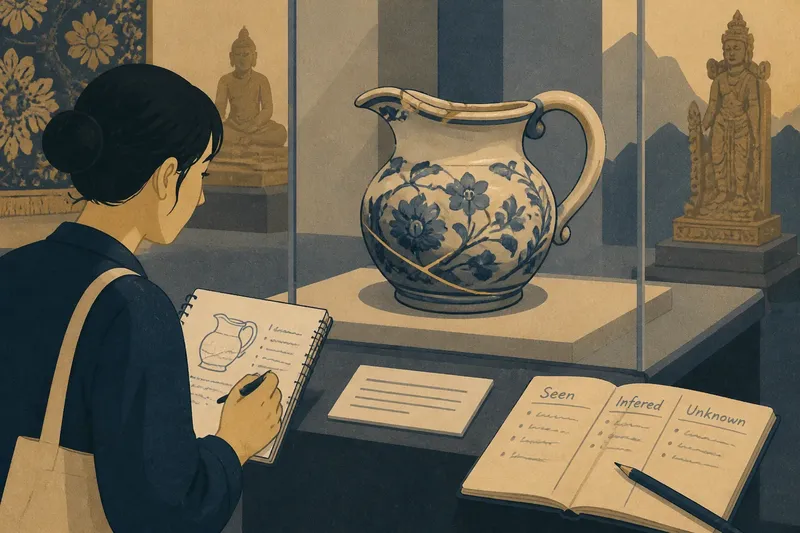
Separate your notes into three kinds:
- Seen: a blue band crosses the bowl, or a textile has a visible seam.
- Inferred: the bowl may have been used for serving, or the textile may have been assembled from separate panels.
- Unknown: the maker, original owner, exact use or route into the collection.
Write a few words or sketch a detail, following the gallery’s rules. “A pale line interrupts the pattern near the foot” gives you something to check again. “An ancient repair” adds a date and interpretation you may not yet have grounds to claim.
Read the label in context
A label offers the museum’s account; it is not a transparent window onto the past. It may name a material, workshop, region, date or cultural practice, drawing on evidence that is not visible in the case. Note what the label says, but keep it distinct from what you observed yourself.
Pay attention to qualifying words such as “attributed to”, “possibly” or “probably”. They signal uncertainty or the limits of an identification. A label may link an object to a court, workshop or regional tradition without naming a maker. Keep that distinction rather than turning a broad attribution into a personal story.
Place names can also hold layered histories. An object may have been made in one location, used in another and later collected elsewhere. If the label gives only a place of manufacture, do not assume it accounts for the object’s whole journey or the people who handled it.
After reading, look back at the object. If the label calls a feature a repair, see whether you can locate it. If it names a material or technique, note whether the text explains the basis for that claim. If it does not, preserve the question instead of filling the gap with a guess.
Work through one object
Imagine you visit a gallery and choose an invented, hypothetical blue-and-white ceramic pouring vessel. Its spout is uneven, the handle curves away from the body, and a pale line crosses the painted pattern near the base. From behind the glass, you cannot tell whether the line is a crack, a join or decoration.
First, you write down the visible details: an uneven spout, a curved handle, blue marks of varying width and a pale line near the base. You infer that the spout may suit pouring, but leave that as a possibility. You do not identify the clay, glaze, workshop or period by appearance alone.
Next, you read the label. In this invented situation, it identifies the vessel as a pouring vessel associated with a named East Asian workshop and period, and describes the pale line as an old repair. You add those as the museum’s claims, not as details you saw before reading. Then you return to the case: the line crosses both the pattern and the surface beneath it, which is consistent with the label, though you cannot see what material was used for the repair or when it was made.
The result is a more useful record, not a solved mystery: visible features in one column, the label’s account in another, and unanswered questions kept separate. That method makes room for the object’s cultural context without pretending a brief gallery visit can reconstruct every part of its history.
Questions about museum objects?
What if I cannot identify the material?
Describe what you can see: matte or glossy, smooth or rough, opaque or translucent. If the label names a material, record it as the museum’s identification rather than claiming you recognised it by sight.
How do I handle a cultural motif?
Describe its shape, colours and position before assigning meaning. Use the label’s account for a stated interpretation, and leave the motif’s significance open if the display does not explain it.
What if the label conflicts with what I see?
Check that you are both referring to the same feature, and notice whether the label uses cautious wording. Record the difference as a question; a viewing angle or a distinction in specialist interpretation may explain it.
Can I do this in a busy gallery?
Keep your pause brief if others are waiting, and step aside before writing or rereading. Choose a quieter object nearby or return later rather than holding your place at the case.
Carry a question onward
Before leaving, write one question the object has sharpened. You might wonder how a pattern was applied, what evidence supports a workshop attribution, or whether a repair belongs to the object’s working life. A focused question marks the boundary between what the display shows and what further evidence would be needed.
For a museum visit built around one object, the place named on the label is a useful starting point, not the whole story. Keep the object’s visible details, the museum’s interpretation and your unanswered questions side by side; that small discipline helps cultural heritage remain specific without reducing a layered history to a single label.