Japanese Urushi Lacquer: How Layers Shape a Bowl
Japanese urushi lacquer reveals how a shaped wooden bowl, prepared ground, repeated coats and decoration work together, helping you read its surface with care.
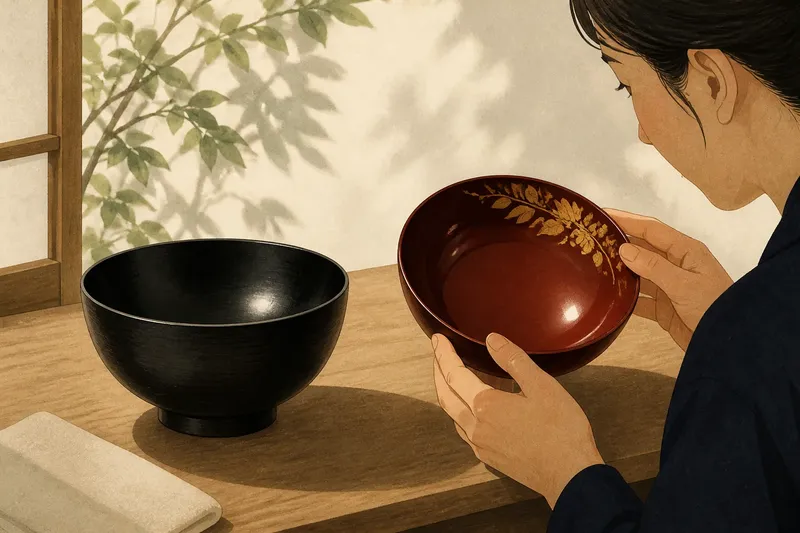
Japanese urushi lacquer can make the grain of a wooden bowl disappear beneath a smooth, deep surface, or leave decoration to catch the eye against a polished ground. Urushi is lacquer made from the sap of the lacquer tree; in Japanese craft, its preparation and application are distinct from the decorative choices that may follow. Look at the bowl’s rim, curve and finish together, rather than treating shine as the whole story.
Different objects and workshops use different materials and methods, so no single visual clue can reveal an entire making process. Still, a close look at a Japanese lacquer bowl can help you distinguish the form beneath the finish, the quality of the visible surface and the role of any ornament.
Urushi and the bowl
Japanese lacquerware, often called urushi ware, includes objects made for different uses and through varied techniques. A wooden bowl offers a useful way to read the relationship between shape and finish: its rim, interior and rounded exterior meet at changing angles, each catching light differently.
In traditional work, urushi is applied in successive coats, with surface preparation and finishing between stages. Some lacquerware also has a prepared ground beneath the visible coats. The precise materials and sequence depend on the object and its maker, so a smooth exterior alone does not identify a particular method.
Read shape and ground
Start with the bowl’s outline. Follow the rim into the interior, then trace the curve down to the foot. These transitions show how the object’s form meets its finished surface without requiring you to guess what lies underneath.
On a wooden bowl, the grain may be visible, partly obscured or hidden by the ground and lacquer. Those appearances can reflect different choices; they are not a simple ranking of workmanship. A regular curve and clean rim let you observe the form clearly, but they do not by themselves prove which preparation method was used.
View the bowl in soft, indirect daylight and gently change your angle. A moving reflection can make slight surface variations easier to notice, while diffuse light keeps decoration and colour legible. Avoid rubbing the surface to investigate it: an old or fragile finish may be vulnerable to handling.
Notice coats and sheen
Repeated urushi coats build the finished surface gradually. Depending on the object and finishing choices, the result may look glossy, subdued or somewhere between. A strong reflection is a surface characteristic, not a dependable measure of age, value or skill.
Compare the interior with the exterior and look at the rim, where the form changes direction. Ask whether the sheen feels consistent with the bowl’s shape and intended appearance. Reflections may shift as you move, so distinguish a change in the light from a change in the lacquer’s colour.
Decoration and restraint
Japanese lacquer objects may be decorated in several ways, including maki-e, in which designs are made with lacquer and metal powders. Other objects rely on colour, surface texture or the form itself, with no prominent motif. The technique and visual effect vary, so do not assume every decorated piece uses the same process.
Follow a design across the bowl rather than reading it as a flat image. A motif placed near the rim meets the vessel’s curve; decoration inside the bowl appears differently when seen from above. Notice where the maker leaves open space as well as where ornament gathers.
Make a close comparison
Imagine you have two Japanese lacquer bowls on a plain table: one has an undecorated dark interior, while the other has a gold-coloured motif near the rim. First, compare their outlines and the way each rim meets the interior. Next, view both in the same soft daylight and shift your position to see how their reflections move. Then inspect where the motif sits in relation to the curve. The resulting comparison separates three observations—form, sheen and decoration—without claiming that one bowl is better or that appearance reveals its full production history.
- If the rim looks even from several viewing angles, then note the form as visually regular; if it appears uneven, compare the opposite side before deciding whether the shape itself is asymmetrical.
- If the wooden grain is visible, then record that the surface allows it to show; if it is hidden, describe the ground or coating as obscuring it rather than guessing the cause.
- If reflections shift across the bowl as you move, then distinguish changing light from colour; if they remain muted, describe the sheen as subdued rather than treating it as a defect.
- If decoration follows the curve, then read it as part of the vessel’s form; if it sits in one confined area, compare that focal point with the undecorated surface.
- If the interior and exterior have different appearances, then note the contrast and inspect each separately; if they look alike, describe the continuity without inferring identical construction.
- If the object is fragile, flaking or of uncertain condition, then avoid cleaning or handling it further and consult a qualified conservator; if it is a modern everyday bowl, follow the maker’s care instructions.
Questions about urushi?
What is urushi lacquer?
Urushi is lacquer made from the sap of the lacquer tree and used in Japanese craft traditions. Its application and finishing vary with the object and the maker’s method.
Why are several coats applied?
Successive coats build the finished surface gradually, with preparation and finishing between stages. The exact sequence depends on the particular object and process.
Does a glossy bowl show better workmanship?
No. Gloss is one possible finish, not a universal standard of quality. Consider how the surface, shape and decoration work together instead.
How should I clean an old lacquer bowl?
Care depends on the object’s condition and finish, so avoid applying household polish or abrasive cleaners on guesswork. For a valuable, fragile or damaged piece, ask a qualified conservator before cleaning it.
Read the whole surface
Japanese urushi lacquer is easier to appreciate when you separate what you can see from what you cannot safely infer. Describe the bowl’s shape, the way light moves across its finish and the placement of any decoration; leave claims about hidden materials or workshop steps to reliable object documentation.
For a useful close look, compare the interior with the rim, then view the same area from another angle. That small change helps distinguish the bowl’s form from reflection and ornament, giving you a clearer reading of how its visible choices fit together.