The Margin as a Meeting Place in Illustrated Manuscripts
The margin in illustrated manuscripts can reshape how a passage is read. Learn to trace the links between words, ornament and marginal images.
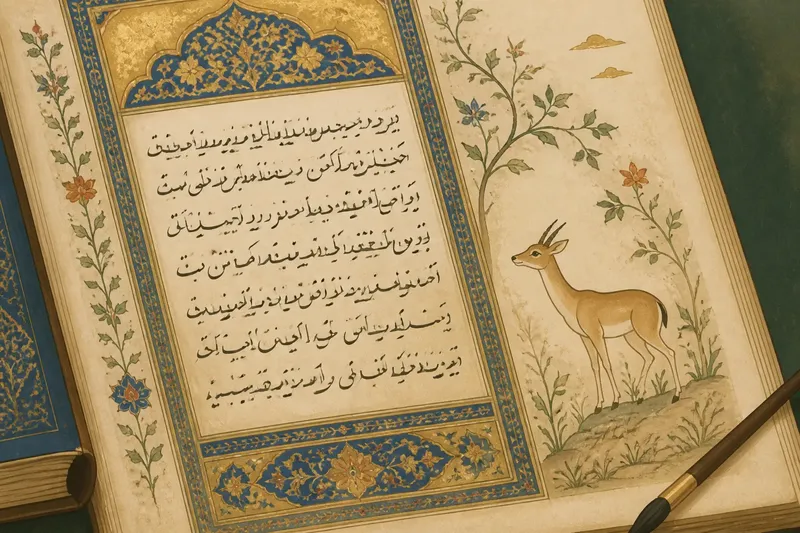
In an illustrated manuscript, a small bird perched beside a line of writing can change how a reader attends to that line. The margin in illustrated manuscripts is not always empty space: it may answer, echo, interrupt or simply sit beside the main text, inviting the eye to make connections without spelling them out.
These relationships are especially rewarding to notice in manuscripts from across Asia and the Middle East, where page layouts, scripts and image traditions vary widely. There is no single rule for reading them. A careful look at placement, direction and repetition can reveal how words, ornament and pictures share the page.
What counts as a margin?
The margin is the space around the main block of writing, but its boundaries can be flexible. A painted border may frame the text; a vine may grow between lines; a figure may lean into the writing area. In some manuscripts, the decoration is so closely woven into the page that “margin” describes a relationship, not a fixed strip of paper.
Look first for the main text block: the area where lines align and continue in a regular rhythm. Then notice what occupies the surrounding space. It might be a floral pattern, a calligraphic flourish, a tiny animal, a cloud motif or a brief annotation. Their relative positions matter. A painted shape at the top of a page may work differently from one tucked beside a particular phrase.
Layout also reflects the physical making of the book. Paper or parchment, ruling, binding and the hand of the scribe all affect how much space is available and where images can sit. A margin may be deliberately composed, or it may have changed as the manuscript was copied, repaired or annotated.
How do images speak?
Marginal images can interact with writing through proximity, direction and visual resemblance. A bird facing towards a line may appear to draw attention to it; a repeated leaf shape may carry a decorative rhythm across the page. These are clues, not fixed translations. Direction can be meaningful, but it can also follow the artist’s preferred composition or the shape of the available space.
Some images echo the subject of a passage, while others introduce a second register: humour, wonder, commentary or an everyday detail. A border pattern may frame a solemn text without illustrating it directly. The reader meets both elements together and decides how strongly they belong to one another.
Colour and scale help, too. A vivid image may pull the eye away from the writing, while a fine, pale line can reward close attention. If a motif appears repeatedly, compare its changing position and form before assuming it carries the same meaning each time.
How should you read the page?
Start with the page as a whole, then move closer. Note where the writing begins and ends, where the margins are most active, and whether the decoration forms a frame or breaks across it. After that, follow one visual feature—perhaps a repeated flower, a curling tendril or a small figure—and see how it relates to nearby words.
Next, read the passage if you can. If the script or language is unfamiliar, a catalogue description or translation can help, but keep the image in view rather than treating it as a mere illustration of the words. Ask whether the picture seems to point towards a specific phrase, offer a parallel, or remain independent.
Say you are looking at a page with a short poem, a gold border and a tiny gazelle near the final line. You might first notice that the gazelle faces towards the poem, then check whether its shape or movement resembles an image in the verse. If the connection is unclear, the useful observation is still that the animal occupies a chosen place beside the ending; you need not force a symbolic answer.
What questions help?
Does every marginal image illustrate the text?
No. Some images may relate to the passage, but others serve as ornament, commentary or a separate visual pleasure. Treat a connection as a possibility to examine, not an assumption.
Can the margin change the meaning of a passage?
It can influence emphasis and mood by directing attention or setting up a contrast. A marginal image does not necessarily alter the words themselves, and its effect may differ among readers.
What if the writing is hard to read?
You can still study spacing, line breaks, repeated motifs and the direction of figures. A reliable caption or translation may clarify the passage, while the page’s visual organisation remains available for close looking.
Are marginal notes the same as marginal images?
No. A note is writing added beside the main text, often by a reader, owner or later hand; an image is a visual element, though it may also be added later. In either case, differences in ink, script or placement can suggest distinct moments of use without proving exactly when they occurred.
What should you avoid assuming?
A familiar symbol does not always mean the same thing across languages, periods or communities. A bird, flower or animal may have several associations, and some may be local to a particular manuscript tradition. Avoid assigning a single meaning from a modern symbol list unless it is supported by information about the page itself.
It is also easy to mistake a damaged or cropped image for an intentional fragment. Binding can conceal part of a margin, and wear may remove colour or fine lines. A digital image may show details clearly but leave out the page’s edges, texture or relation to neighbouring pages. When possible, compare the full page and its catalogue description.
Keep observation separate from interpretation: “the tendril curves towards the text” is something you can see; “the tendril guides the reader to this particular idea” is a reading that needs support. This distinction makes close looking more precise, not less imaginative.
Why the margin matters
The margin in illustrated manuscripts gives readers room to notice how a page works beyond its words. Text, ornament and image may reinforce one another, pull in different directions or remain intriguingly unresolved. That uncertainty is part of the encounter: a margin can invite interpretation without closing it down.
When you next look at a manuscript, choose one small detail and follow its relation to the writing. A border that changes near a heading, or an animal placed beside a line, may tell you how the page asks to be seen. The best reading begins with what is actually there, then leaves space for more than one plausible connection.